
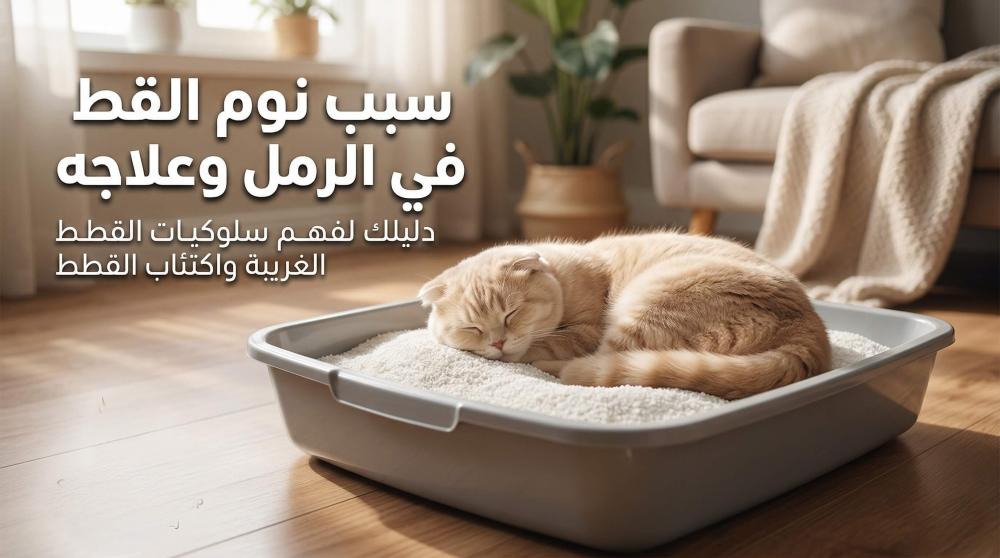
Have you ever seen your cat exhibiting strange behavior and wondered if it's normal or if you should consult a specialist? Cats are mysterious creatures, and every breeder knows that there is an endless list of strange cat behaviors , such as sudden running or kneading on pillows.
But when you notice that your cat sleeps in the litter box , you might wonder: Should I be worried, or is it just a normal , unusual cat behavior ? In this article, we will clearly analyze why cats sleep in the sand , the health and psychological reasons behind it, and we will help you choose the right type of sand for your cat.
Why does a cat sleep in the sand?
The reasons behind this habit vary. Some are psychological, related to a condition the cat is going through, while others may be health-related, requiring concern and immediate intervention to accurately determine why the cat is sleeping in the sand .
Feeling safe and having privacy:
Sometimes, a cat sleeps in the litter box for comfort and security. For a cat, the litter box is the place that most strongly retains its scent.
- In cases of moving to a new house or having strange guests, the cat resorts to the box because it feels sovereign and safe there.
- The high walls of the box provide protection from the sides, making it an ideal place to hide when confused.
Health problems:
Before assuming it's just normal behavior, the underlying medical condition should be checked; a cat sleeping in the litter box could be due to:
Urinary tract infections:
The cat feels a constant urge to urinate, so it decides to stay close to the place.
Digestive system problems:
Such as severe constipation that makes him prefer not to move away from the box.
Joint pain:
Especially in large cats who may find it difficult to jump up to reach their usual bed.
Psychological aspect: Feline depression
Is it possible that a cat sleeping in the litter box is depressed ? Do cats feel sadness? Yes, depression in cats is a major cause of changes in sleeping habits, reflecting a poor psychological state resulting from the loss of a friend or a lack of interaction and play. Sleeping in a confined and isolated space is a defense mechanism for coping with psychological stress.
What are the causes of sudden depression in cats?
- Loss of routine: Cats cherish a daily schedule; changing the mealtime or the furniture placement can cause them shock.
- Loss: The departure of a family member or another pet that shared the residence.
- Deadly boredom: The lack of mental stimulation or [interactive cat toys] makes the cat feel useless.
Symptoms of depression in cats:
- Neglect of personal hygiene: If your cat stops licking its fur and its hair starts to look dull, this is a strong sign of depression.
- Changes in appetite: stopping eating or even eating unusually voraciously to relieve stress.
- Change in the tone of the meow: a long, sad meow or a sudden, complete silence.
- Excessive sleep: A depressed cat will sleep in deserted corners or inside a box for long hours without any desire to play.
Why does a cat choose the sandbox when it feels sad or depressed?
In animal behavior, the scents concentrated in a litter box represent a cat's personal fingerprint. When stressed, a cat seeks out the place that most closely resembles its own scent. Sleeping surrounded by this scent gives it a false sense of control and security amidst its distress.
Regional behavior and resource protection:
We can't discuss unusual cat behaviors without addressing their territorial nature. A cat sees your home as a kingdom to be protected. If you notice your cat sleeping in the litter box in a house with multiple pets, you're likely witnessing a silent power struggle.
Protecting resources:
The litter box is a vital resource. When a new cat enters the home, the existing cat may feel its territory is threatened and resort to sleeping in the box as a clear message: "This place is mine." This can escalate into aggression if left unaddressed.
Competition sleep for new kittens:
If you adopt a new cat and find it sleeping in the litter box, it could be due to territorial bullying. The new cat sleeps in the box to secure a spot and assert its right to use it, fearing the dominant cat.
The importance of choosing natural cat litter:
If your cat insists on spending a lot of time in the litter box, the type of litter becomes a crucial factor. Using medical-grade cat litter (such as that made with activated carbon or silica) helps with:
Monitoring health status:
Some types of medical cat litter change color when in contact with a cat's urine if the cat has kidney problems or infections.
Reducing dust:
Sleeping in sand full of dust may cause respiratory problems for your cat, so we advise you to use medical cat litter that is free of dust and the accompanying odors that cause allergies, which gives it a better feeling.
Odor control:
To ensure that bacteria do not transfer to the cat's fur while it sleeps, you can choose types of natural cat litter that are free of odors and perfumes.
How do you deal with this behavior?
Whatever the reason for a cat sleeping in the sand , it is one of the strange cat behaviors that requires immediate action to address:
Providing convenient alternatives:
Place a bed with high, cave-like edges in a quiet spot to create an attractive alternative to a box.
Improving the surrounding environment:
Play with your cat more to raise its happiness hormone and fight any signs of depression, and provide interactive toys so that your cat has a fun time away from boredom and depression.
Superior cleanliness:
If the behavior continues, make sure to clean the box regularly to prevent the cat from developing skin diseases.
Observe your cat's body language:
Half-closed eyes and ears pointing backwards while sleeping in the sand are a clear sign that the cat is not well.
Advice for breeders:
Distributing the boxes in separate locations, rather than next to each other, breaks up territorial control and gives each cat its own space, thus reducing the likelihood of feline depression resulting from ongoing conflicts.
What is the role of the Seventh Bird store in dealing with strange cat behaviors?
At Seventh Bird, we understand that noticing my cat sleeping in the litter box can be alarming, so we've stocked a selection of:
High-quality medical cat litter that helps in the early detection of health problems.
The cave bed gives your cat a sense of security as an ideal alternative to a crate.
Litter boxes come in various shapes and sizes so you can choose what suits your cat's comfort and safety.
Our expert team is always available to advise on the best products that help reduce stress and treat cat depression to ensure a calm and happy home environment for your cat.
Plastic pet house: the perfect solution.
An indoor and outdoor plastic house provides ample space suitable for your cat's comfort and privacy, giving her a sense of security and security within her own home, her personal territory, where no one else is allowed to approach.
Made from safe materials suitable for cats and dogs. Available at the Seventh Bird store :
Seven Bird Plastic Pet House 60*60*60 cm
In conclusion:
Remember that a cat sleeping in the litter box isn't normal behavior; it's often a way of communicating health, psychological, or territorial signals. Understanding these cues and providing a suitable environment is what distinguishes a professional catter. If your cat repeatedly sleeps in the litter box , don't hesitate to consult your veterinarian.
Frequently asked questions:
If my cat sleeps in the litter box, does that necessarily mean she is sick?
Not always; the cause could be psychological, such as stress, or territorial behavior to protect its resources, but it is always advisable to have it examined medically to rule out urinary tract infections.
How can I tell if my cat is suffering from depression and not just laziness?
A depressed cat shows neglect in cleaning its fur, loss of appetite, and complete isolation, while a lazy cat reacts to play and rewards normally during its active times.
What is the best type of litter for cats that spend a lot of time in the box?
It is preferable to use natural, dust-free cat litter scented with soothing natural ingredients to ensure that the cat's respiratory system is not irritated while it is constantly inside the box.
I have two cats and they are fighting over the box, what should I do?
Three sandboxes should be provided and distributed in different locations within the house to break up territorial control and prevent resource-protecting behavior.
Read more articles from The Seventh Bird:
The history of Saudi Arabia's founding day and the most prominent events of Founding Day 2026
In pictures: Your guide to choosing the most beautiful and best cat breeds for raising
Don't rush! Here are the best types of parrots to keep and the most popular types of parrots.